Showing posts with label caffeine. Show all posts

Drugs causing addiction

Drugs causing addiction

Drugs known to cause addiction include illegal drugs as well as prescription or over-the-counter drugs.

* Stimulants:
o Amphetamine and Methamphetamine;
o Caffeine;
o Cocaine;
o Nicotine.

* Sedatives and Hypnotics:
o Alcohol;
o Barbiturates;
o Benzodiazepines, particularly alprazolam, clonazepam, temazepam, and nimetazepam;
o Methaqualone and the related quinazolinone sedative-hypnotics;
o GHB and analogues (specifically GBL).

* Opiate and Opioid analgesics;
o Morphine and Codeine, the two naturally-occurring opiate analgesics;
o Semi-synthetic opiates, such as Heroin (Diacetylmorphine), Oxycodone, and Hydromorphone;
o Fully synthetic opiods, such as Fentanyl and its analogs, Meperidine/Pethidine, and Methadone;
* Anabolic steroids.

Addictive drugs also includes a large number of substrates that are currently considered to have no medical value and are not available over the counter or by prescription.

Uses of psychoactive substances

psychoactive substances

Psychoactive substances are used by humans for a number of different purposes, both legal and illicit.

Anesthesia

General anesthetics are a class of psychoactive drug used on patients to block pain and other sensations. Most anesthetics induce unconsciousness, which allows patients to undergo medical procedures like surgery without physical pain or emotional trauma. To induce unconsciousness, anesthetics affect the GABA and NMDA systems. For example, halothane is a GABA agonist, and ketamine is an NMDA receptor antagonist.

Painkillers

Psychoactive drugs are often prescribed to manage pain. As the subjective experience of pain is regulated by endorphins, neurochemicals that are endogenous opioids, pain can be managed using psychoactives that operate on this neurotransmitter system. This class of drugs includes narcotics, like morphine and codeine, and also NSAIDs such as aspirin and ibuprofen.

Psychiatric medications

Psychiatric medications are prescribed for the management of mental and emotional disorders. There are 6 major classes of psychiatric medications:

* Antidepressants, which are used to treat disparate disorders such as clinical depression, dysthymia, anxiety, eating disorders and borderline personality disorder.
* Stimulants, which are used to treat disorders such as attention deficit disorder and narcolepsy and to suppress the appetite.
* Antipsychotics, which are used to treat psychoses such as schizophrenia and mania.
* Mood stabilizers, which are used to treat bipolar disorder and schizoaffective disorder.
* Anxiolytics, which are used to treat anxiety disorders.
* Depressants, which are used as hypnotics, sedatives, and anesthetics.

Recreational drugs

Many psychoactive substances are used for their mood and perception altering effects, including those with accepted uses in medicine and psychiatry. Classes of drugs frequently used recreationally include:

* Stimulants, which elevate the central nervous system. These are used recreationally for their euphoric and performance-enhancing effects.
* Hallucinogens, which induce perceptual and cognitive distortions.
* Hypnotics, which are used recreationally to because they induce inebriation.
* Analgesics, which are used recreationally because of their euphoric effects.

Examples include caffeine, alcohol, cocaine, LSD, and cannabis.

In many cultures, possessing or having used recreational drugs is seen as a status symbol. Recreational drugs, especially those known as club drugs, are seen as status symbols at social events such as at nightclubs and parties. This is true of many cultures throughout history; drugs have been viewed as status symbols since ancient times. For example, in ancient Egypt, gods were commonly pictured holding hallucinogenic plants.

How should I take acetaminophen, aspirin, and caffeine?

symptoms aspirin

Take acetaminophen, aspirin, and caffeine exactly as directed by your doctor or follow the instructions on the package. If you do not understand these directions, ask your pharmacist, nurse or doctor to explain them to you.

Take each tablet or capsule with a full glass of water to ensure adequate swallowing of the medication.

Do not take more acetaminophen, aspirin, and caffeine than is directed. Too much acetaminophen, aspirin, and caffeine may be harmful.

If your symptoms do not improve, or if they get worse, stop using acetaminophen, aspirin, and caffeine and contact your doctor.

Due to the caffeine in this product, taking acetaminophen, aspirin, and caffeine before bed may result in difficulty sleeping.
Store acetaminophen, aspirin, and caffeine at room temperature away from heat and moisture.

Before taking acetaminophen, aspirin, and caffeine

aspirin and caffeine

What should I discuss with my healthcare provider before taking acetaminophen, aspirin, and caffeine?

Do not drink alcohol during treatment with acetaminophen, aspirin, and caffeine. Together, alcohol, acetaminophen, and aspirin can be damaging to the liver and stomach. If you drink more than three alcoholic beverages a day, talk to your doctor before taking acetaminophen, aspirin, and caffeine.

Before taking this medication, tell your doctor if you:

* have an allergy to or have had problems after taking aspirin;
* have an allergy to or have had problems after taking a nonsteroidal anti-inflammatory drug (NSAID) such as ibuprofen (Motrin, Advil, others), naproxen (Aleve, Naprosyn, Anaprox, others), indomethacin (Indocin), ketoprofen (Orudis KT, Orudis, Oruvail), nabumetone (Relafen), oxaprozin (Daypro), and others;
* drink more than three alcoholic beverages a day;
* have never had migraines diagnosed by a doctor;
* have a headache that is different from or more severe than your usual migraines;
* have daily headaches;
* have a headache following or caused by a head injury, exertion, coughing, or bending;
* experienced your first headache after age 50;
* have an ulcer or bleeding in the stomach;
* have liver disease;
* have kidney disease;
* have a bleeding or blood clotting disorder (e.g., hemophilia);
* have high blood pressure;
* have gout;
* have asthma;
* have nasal polyps;
* have anxiety problems or insomnia.

You may not be able to take acetaminophen, aspirin, and caffeine or you may require a dosage adjustment or special monitoring during treatment if you have any of the conditions listed above.

It is not known whether acetaminophen, aspirin, and caffeine will be harmful to unborn baby. However, it is known that aspirin taken during pregnancy may affect an unborn baby’s heart, reduce birth weight, and have other dangerous effects on the unborn baby. Do not take acetaminophen, aspirin, and caffeine without first talking to your doctor if you are pregnant or could become pregnant during treatment.

Acetaminophen, aspirin, and caffeine may affect a nursing baby. Do not take this medicine without first talking to your doctor if you are breast-feeding a baby.

Do not use acetaminophen, aspirin, and caffeine to treat a child or teenager who has a fever, flu symptoms, or chicken pox without first talking to the child’s doctor. In children younger than 18 years of age, aspirin may increase the risk of Reye"s syndrome, a rare but often fatal condition.


What is acetaminophen, aspirin, and caffeine?

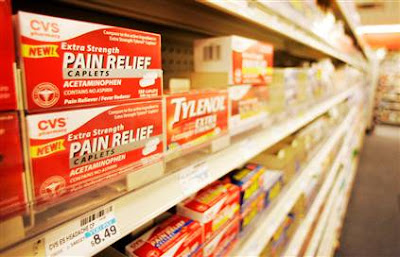
pain relief caplets

Acetaminophen is a pain reliever and a fever reducer.

Aspirin is in a class of drugs called salicylates. It works by reducing substances in the body that cause pain and inflammation.

Caffeine is used in this product to increase the pain relieving effects of acetaminophen and aspirin.

Together, acetaminophen, aspirin, and caffeine are used to treat pain from conditions such as headache (including migraine), muscle aches, menstrual cramps, arthritis, backache, toothaches, colds and sinus infections.

Acetaminophen, aspirin, and caffeine may also be used for purposes other than those listed in this medication guide.

Legal definition of drugs

Some governments define the term drug by law. In the United States, the Federal Food, Drug, and Cosmetic Act definition of "drug" includes "articles intended for use in the diagnosis, cure, mitigation, treatment, or prevention of disease in man or other animals" and "articles (other than food) intended to affect the structure or any function of the body of man or other animals." Consistent with that definition, the U.S. separately defines narcotic drugs and controlled substances, which may include non-drugs, and explicitly excludes tobacco, caffeine and alcoholic beverages.

The use of drugs, the possession or distribution of which is unlawful under the Controlled Substances Act. Such term does not include the use of a drug taken under supervision by a licensed health care professional, or other uses authorized by the Controlled Substances Act or other provisions of Federal law. 29 USC

1. A substance used in the diagnosis, treatment, or prevention of a disease or as a component of a medication.
2. Such a substance as recognized or defined by the US Food and Drug Administration.
3. A chemical substance, such as a narcotic or hallucinogen, that affects the central nervous system, causing changes in behavior and often addiction.
4. To administer a drug, especially in an overly large quantity, to an individual.
5. To stupefy or dull with or as if with a drug to narcotize.

Recreation and spiritual. Nootropics

Recreational drugs use is the use of psychoactive substances to have fun, for the experience, or to enhance an already positive experience. National laws prohibit the use of many different recreational drugs and medicinal drugs that have the potential for recreational use are heavily regulated. Many other recreational drugs on the other hand are legal, widely culturally accepted, and at the most have an age restriction on using and/or purchasing them. These include alcohol, tobacco, betel nut, and caffeine products.

The spiritual and religious use of drugs has been occurring since the dawn of our species. Drugs that are considered to have spiritual or religious use are called entheogens. Some religions are based completely off of the use of certain drugs. Entheogens are mostly hallucinogens, being either psychedelics or deliriants, but some are also stimulants and sedatives.

Nootropics, also commonly referred to as "smart drugs", are drugs that are claimed to improve human cognitive abilities. Nootropics are used to improve memory, concentration, thought, mood, learning, and many others things. Some nootropics are now beginning to be used to treat certain diseases such as attention-deficit hyperactivity disorder, Parkinson's disease, and Alzheimer's disease. They are also commonly used to regain brain function lost during aging.